
Astigmatism is a common refractive error that affects the eye’s ability to focus light evenly to the retina, resulting in blurry or distorted vision. Understanding the symptoms, causes, and treatments of astigmatism can help patients manage their vision health more effectively.
If you or someone you love has an astigmatism, keep reading to learn more about symptoms, causes, diagnosis, and treatments that may be available to you through an experienced eye doctor near you.
What is Astigmatism?
It may surprise you that many people have some degree of astigmatism. Ideally, our eyeballs are shaped like perfectly round balls, and when light comes in, it bends evenly, which allows us to see clearly.
However, in someone with astigmatism, the cornea is more egg-shaped, and the light coming in gets bent more in one direction than another, which means objects are only partially in focus. Astigmatism can affect your vision, whether looking at something close-up or further away, causing things to look wavy and blurry.
It is also common for people with astigmatism to be nearsighted (myopia) or farsighted (hyperopia). These three conditions are called refractive errors because they influence how your eyes refract or bend light.
The good news is that astigmatism is usually easy for an experienced eye doctor to correct with contacts, eyeglasses, or surgery.
Symptoms of Astigmatism
Various symptoms occur with astigmatism, including:
- Distorted or blurry vision
- Headaches
- Eye strain
- Challenging to see at night
- Seeing halos or a glare around lights
- Having to squint to see clearly
- Fatigue
- Trouble reading
Making an appointment with your local eye specialist if you or your child are experiencing any of these symptoms to check for vision issues can help ensure you get the necessary treatment as soon as possible.
Types of Astigmatism
The two main types of astigmatism are the following:
- Corneal astigmatism is when the patient’s cornea has an irregular shape.
- Lenticular astigmatism is when the patient’s lens in the eye has an irregular shape and is often caused by cataracts.
Occasionally, some patients will have both lenticular and corneal astigmatism.
Causes of Astigmatism
While some people are born with astigmatism, others develop it later in life as adults. Astigmatism is prevalent and affects 1 in 3 people, and it can also improve or worsen over time.
Astigmatism is often hereditary and is considered a condition that parents pass down to their children. When babies are born with astigmatism, it will usually dissipate or go away before the first birthday.
It is important to note that if your child has an untreated vision condition, they may have difficulty reading at school. It could also lead to being incorrectly diagnosed with a learning disorder. Other causes include the following circumstances:
- If your eyelids are putting too much pressure on your cornea
- Eye injuries
- Keratoconus is when your cornea changes shape and becomes more cone-shaped than a dome.
- Complications following eye surgery
You may not notice an astigmatism right away as the symptoms can occur slowly. If you notice changes in your vision, make an appointment with an eye doctor. There is no way to prevent astigmatism.
How Will Your Eye Care Specialist Diagnose Astigmatism?
At your appointment, your eye doctor will test the sharpness of your eyesight and ask you to read an eye chart. They will also utilize special tools to measure your vision, including the following:
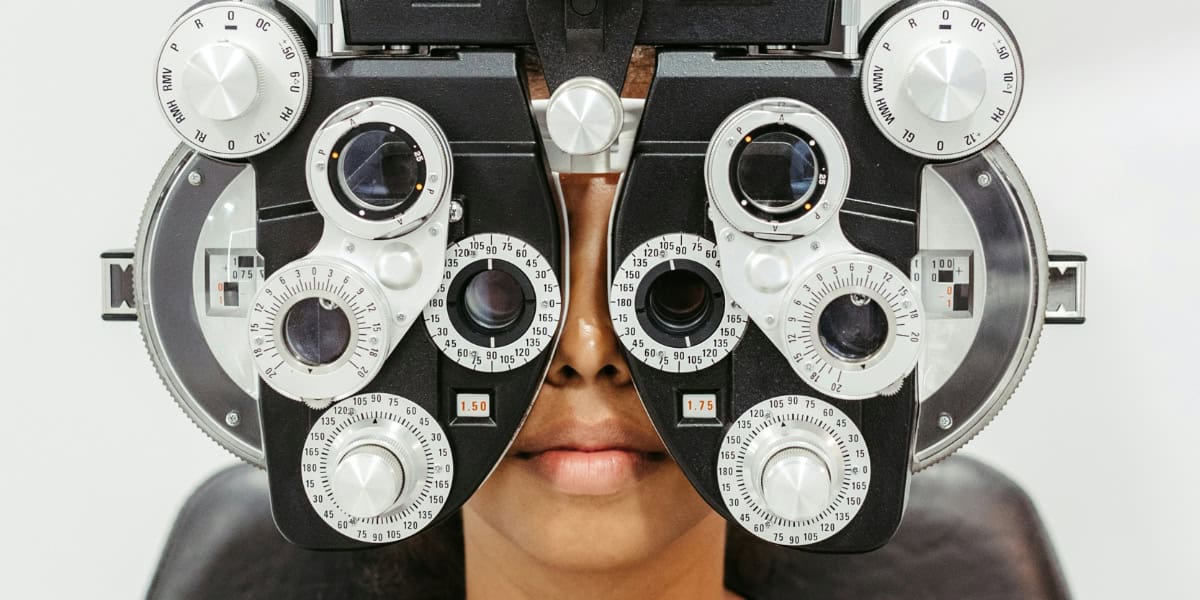
- Phoropter — During this test, your doctor will have you look through a series of lenses to determine which gives you the clearest vision.
- Keratometer — During this procedure, the doctor will use this machine to measure the bend in the center of your cornea. It will show the flattest and the steepest curves. Your doctor will utilize these measurements to understand the shape of your cornea and how well it can focus.
- Autorefractor — Your doctor will use this device to shine a light into your eye to see how it changes when the light bounces off the back. This test will give your doctor an idea of which lenses would be best for you.
- Corneal topographer — One of the best things about this technology is that it will give your doctor detailed information about your cornea shape. Your doctor will instruct you to look at a specific point as the device takes thousands of tiny measurements. A computer will use the data to build a color map of your cornea. Your eye doctor can use this information to help determine if you need surgery to correct astigmatism or a cataract. Your eye doctor can also use the data to fit your eyes with contacts and help diagnose keratoconus correctly.
Astigmatism Treatments
Contacts or glasses can correct almost all cases of astigmatism, depending on the patient’s level of astigmatism. If your astigmatism is minor, you may not need contacts or glasses.
Eyeglasses for Astigmatism
Your eye doctor may recommend eyeglasses to help counteract the shape of your cornea or lens that is causing your vision to be blurry. Depending on the level of correction your eyes need, your eyeglasses may make the walls or floors look tilted; however, this effect typically goes away as you adjust to wearing them. For patients with severe astigmatism, it could take a week or more.
Your doctor will recommend the best routine to help you adjust to wearing your new glasses. If your vision does not improve, request that your doctor double-check your prescription.
Contact Lenses for Astigmatism
Contact lenses may also be an option for you; however, you will require a particular pair. When wearing contacts, they rotate when you blink. Soft lenses used for astigmatism are called toric lenses and will return to the same spot each time.
If your astigmatism is more severe, rigid, gas-permeable contact lenses are generally the best choice. Your doctor may recommend using them for your regular contacts or for a procedure called orthokeratology. Usually, the patient will wear the lenses when sleeping to help reshape the cornea. The lenses must be worn periodically for your cornea to hold the new shape.
PRK Surgery for Astigmatism
PRK (photorefractive keratectomy), also known as AST (advanced surface treatment) or Surface Treatment, is a procedure that can correct your astigmatism. During this procedure, your eye doctor will numb your eye using drops and remove the epithelium (outer layer) of your cornea. They will then use a laser to reshape your cornea.
Do You Have Astigmatism? New Vision Eye Center in Vero Beach is Here To Help
At New Vision Eye Center, our world-class doctors Are here to help. We are leaders in laser vision correction, YAG laser surgery, general ophthalmology, custom cataract surgery, glaucoma surgery, surgical and medical retinal care, eyelid surgery, and corneal transplants.
We use the latest technology and minimally invasive treatments to ensure you receive the best care and results possible. We want to help you improve your vision and quality of life.
Contact us today for a vision screening and appointment for better vision tomorrow.